
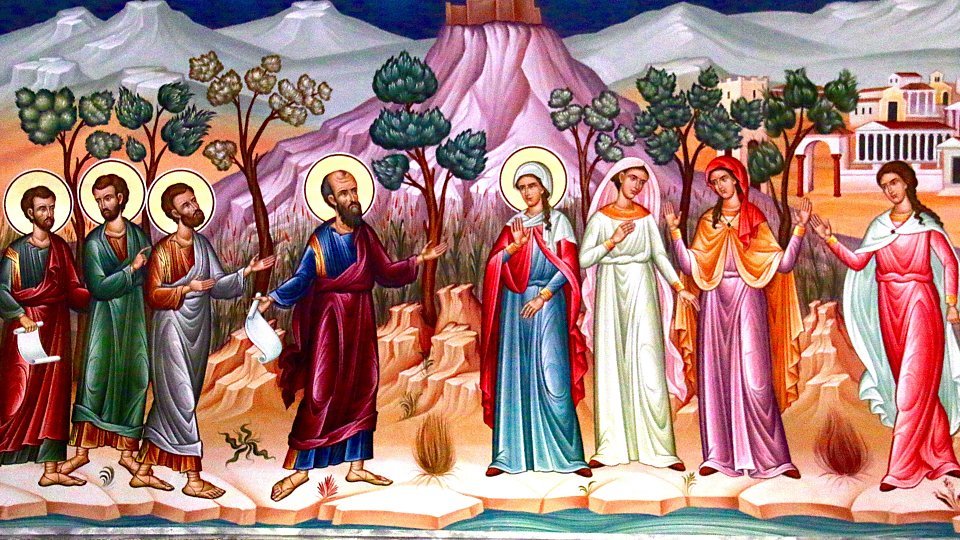
“And a vision appeared to Paul in the night: a man of Macedonia was standing there, urging him and saying, ‘Come over to Macedonia and help us’” (Acts 16:9).
Paul had a dream. His missionary plans kept getting thwarted by the Holy Spirit.
He wanted to push toward the East into parts beyond Galatia. Stop, he was told. He then turned his attention toward Bithynia – “the Spirit of Jesus did not allow them” (Acts 16:5).
These regions may have been declared off limits to Paul because the Apostle Peter and his crew were already busy there. Other harvest fields lay unattended and in need of laborers.
Instead, by the man in his dream, Paul was implored to go to the West, to take the Gospel into Europe. And he and Silas did just that. They boarded a ship at Troas and traveled straight across the Aegean Sea to Philippi.
This was a significant city in this region of Macedonia. The environs’ resources – gold deposits in particular — helped propel the empire-building efforts of Alexander the Great and his father before him.
At the time of Paul’s arrival, Philippi was a colonial town populated by retired soldiers who’d served in the Roman legions. The character of the town was particularly pagan, and there was no known synagogue.
A Gentile City
Unsurprisingly, the apostle to the Gentiles had been called to a place that was almost totally Gentile. This reality did not change Paul’s mode of operation. He and Silas would first seek out the Jewish residents of Philippi. The priority exhibited in this practice is defined by Paul in his letter to the Romans: “For I am not ashamed of the Gospel, for it is the power of God for salvation to everyone who believes, to the Jew first and also to the Greek [or Gentiles]” (Romans 1:16).
“To the Jew first” seems a quite exclusive and prejudicial statement, and so it is. The Lord called Abraham. He believed God and it was counted to him as righteousness. He is referred to as the “friend of God” (see James 2:23).
To this early friend, the Lord covenanted to make his descendants as the stars of the sky, lights to the world – numerous and ever-multiplying. The Old Testament catalogs the history of these people of Abraham, the Hebrews who would be chosen as the nation of witness for Yahweh.
This status is best exemplified in the Person of Jesus, born to the Jewish teenager Mary and her betrothed, Joseph. Both of these people were connected to the line of King David, the shepherd boy whose family had been chosen as the throne people for the nation.
John’s gospel opens with the statement that the Son came to His own, to the people of David and Israel, and His own refused Him – “He came to His own, and His own people did not receive Him” (John 1:11).
Jesus went to the Jews first and Paul would follow His example.
And so there was something of a “beach reach” conducted on their first Sabbath in the town. The Jews of the place had to be located. Down by the river, a ladies prayer meeting was happening. Mission accomplished: “We sat down and spoke to the women gathered there” (Acts 16:13).
A Woman of Means
Among those at prayer that Sabbath was Lydia, a God-fearing Gentile. She was also a preeminent business woman. How do we know this? The text tells us she was “a dealer in purple cloth from Thyatira” – a city in Asia known for its textile production.
Purple cloth was expensive and coveted by the royals and the wealthy. Consider this: King Herod mocked Christ as King of the Jews by gifting Him “splendid clothing” — a purple robe to wear on His way to the Cross (see Luke 23:11).
Gospel-sharing is not a formula to be perfected. Rather, it is the telling of the Truth in a place and time arranged by God and God alone. Share on XThe purple dye was extracted from shellfish and squid found in the seas of the region. Lydia, it seems, was involved in the production and sale of high fashion stuff. Perhaps, as Timothy Keller suggests, she even owned a boutique in Philippi. She came to the city to make money and got connected with the few Jews who lived there.
We do know from the Scriptures that Lydia owned a sizeable property, a mansion of some sort that became the site of a house church and a frequent lodging place for Paul and his traveling parties.
Beyond all else, Lydia possessed something most valuable – a ready heart. The Word was delivered; she listened, and “the Lord opened her heart to respond to what Paul was saying” (Acts 16:14).
Here, we see the power of the Spirit and His work in evangelism. There’s no technique described here. Gospel-sharing is not a formula to be perfected. Rather, it is the telling of the Truth in a place and time arranged by God and God alone.
Paul talked, and as a result, this well-to-do woman gave her life to Christ. After this conversation, her family got the Good News also, for the passage explains she and her household were baptized.
It all happened down by the river outside of Philippi.
Winning the West
Another thing that this story makes clear is that women were quite important to the spread of Christianity. The work of the ministry was not closed to them. We do not see them depicted as preachers and teachers in the New Testament, but we do see them active and involved. Some “ministered unto [Jesus] of their substance” (see Luke 8:3).
Lydia, a woman likely used to getting her way, wanted to do exactly as these women did for the Savior. She was a woman of substance and means, and she was ready to be a blessing to the ministry of Paul. “… She urged us, ‘If you consider me a believer in the Lord, come and stay at my house.’ And she persuaded us” (Acts 16:15).
A dream had opened Paul to a new direction and sent him on his way to Philippi. A woman was there who was open to the Message. A home base was established for the mission to take root in Europe.
This marked the beginning of how the West was won for the Lord.
Here, in this place, we are talking about Jesus. We’re a small group, but a faithful one. Our hearts have heard the Truth. We are growing in the way, the truth, and the life of Christ.
The Bible is full of these moments. Someone with a message meets some people willing to listen.
Do not ever, ever despise the day of small things. Read on in Acts 16 and note what was launched down by the riverside.
Demon Defeat, Earth Shaken
The devil got busy in his opposition. First, he stirred a fortune-telling slave girl to mock and direct sarcastic taunts at the man of God – “These men proclaim the way of salvation … ‘’ she shouted with a demon-fueled sneer, day after day until Paul wound up “greatly annoyed” and commanded the spirit depart from her.
This exorcism of sorts spoiled a money-making operation run by the slave girl’s owners. These pimps stirred up a rage against Paul and Silas and managed to get the Philippian officials to flog and jail them.
Chained in their dank cell, these men began to sing at midnight. And that song reverberated to Heaven and back in such a way that the earth was shaken. The tremors broke all of the chains off the hands locked in that prison.
The episode so affected the jailer that he was ready to commit suicide before Paul intervened. “Do yourself no harm, for we are all here” (Acts 16:28). Astonished, this man fell at the feet of Paul and Silas, asking. “What must I do to be saved?” Answer: “Believe on the Lord Jesus Christ.”
Again, the Word was spoken. A man and his household responded and were baptized into the faith.
The works of the Lord are wonderful. Our part is to hear and obey for there’s no other way.
Let us listen and let the Savior use us. There are ready hearted people everywhere – by the riversides and working in jailhouses, in the markets, and all over our neighborhoods.
God will shake things up and people will believe and be saved.

- A Diligent Heart, an Obedient Redeemer - November 11, 2026
- A Steadfastly Minded Friend - November 4, 2026
- Shake Off the Snake - October 28, 2026