
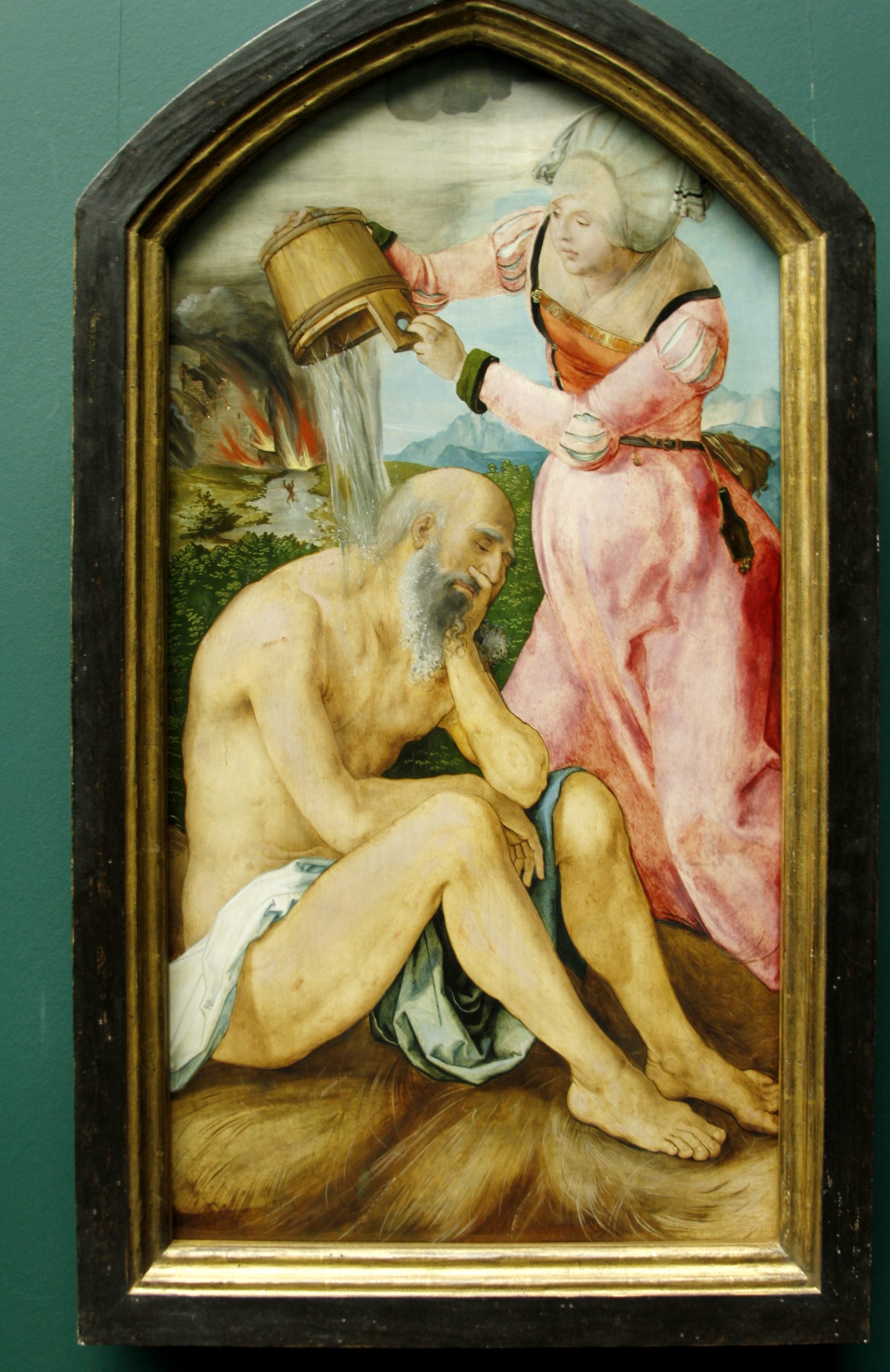
“Job arose and tore his robe and shaved his head and fell on the ground and worshiped. And he said, ‘Naked I came from my mother’s womb, and naked shall I return. The Lord gave, and the Lord has taken away; blessed be the name of the Lord.’
“In all this Job did not sin or charge God with wrong.” (Job 1:20-22)
Phase 1 of Job’s troubles brought him low. He lost all of his children. They were the very people who were always on his heart. He made constant intercession and sacrifices on their behalf.
The goods, the flocks, the herds – those could be replaced. But the sons and the daughters, the loss of them weighed heavy on him. At this news, Job stood up, tore his robe, and fell on his face.
His was not a stoic response. He did not grin and bear the situation. He did not rely on his own strength or character. He let his feelings loose.
Grief overcame him, and yet the words indicate that Job still gave himself to worship. He blessed “the Name of the Lord” and refused to “charge God with wrong.”
These small phrases reveal the relationship Job had with the Lord. He knew God. He trusted God. Even in the throes of his pain and misunderstanding, he held fast to the Name and character of his Creator.
The Nature of Satan
We start to see in this story the hardening of the battle lines in this cosmic and invisible conflict. Satan’s mode of operation involves the constant push to “charge God with wrong.”
Job suffers great losses and yet still sees God as good and perfect in His ways. This, the devil cannot do. He simmered in the sense of superiority he felt in his being.
What was the devil made to be? A worshipper, a lead worshipper assigned a privileged position to magnify and reflect the Light. “Lucifer” means “light-bearer” or “star of the morning” as we read in Isaiah 14:12.
It was the worship expressed by Job that must have driven Satan mad. To see him glorify God in spite of the losses he faced frustrated the devil.
Ezekiel 28 describes Satan as an “anointed cherub” – that is, he was especially touched with a commission from the Almighty. Gifted and talented, bright and beautiful, he possessed a holy assignment that set him near the Throne of God. He was likely privy to eternal conversations that went on among the Father, the Son, and the Spirit.
The testimony of the Lord regarding this cherub goes like this: “… I established you; you were on the holy mountain of God … You were perfect in your ways from the day that you were created, till iniquity was found in you” (see Ezekiel 28:14).
Satan became the victim of his own contempt. Self-orientation stirred his mind to consider himself to be worthy of praise. He sought to ascend to the heavens, to set his throne, and become “as the Most High” (see Isaiah 14:13-14).
Satan somehow came to believe that he could be better at being God than the God who made him to be all that he is. Share on XThough owing his very existence and makeup to his Maker, Satan somehow came to believe that he could be better at being God than the God who made him to be all that he is.
And so he continues to charge God with wrong. Satan did this among the host of angels and a third of these creatures were taken captive by his accusations. They joined forces and thus Hell became a reality – it is “the everlasting fire prepared for the devil and his angels” (see Matthew 25:41).
As the serpent in the Garden, the devil charged the Lord with keeping blind the man and the woman by forbidding them to eat from the Tree of the Knowledge of God and Evil. “For God knows that in the day you eat of it your eyes will be opened, and you will be like God, knowing good and evil” (see Genesis 3:4).
God is love, and He fashioned man to be loved by Him – He did this to such a depth as to put His very breath into the dust that He formed and called Adam. This truth should open our hearts to the central point of Satan’s lies and attacks.
God lives in men – in all men. His breath is what accounts for every living soul. And every one of us carries His image and in this holy image we are the supreme objects of His desire.
Why did Satan set his sights on Job? He sees that the love of God for this man and between them is really the only line of offense he has to get at the Lord.
In deceiving man to disobey the Lord, Satan relishes the opportunity to stir grief at the Throne of Glory. Hell cannot defeat God, but it can stimulate activity that makes the Lord feel the sting of death.
And that sting is felt most acutely when we turn our faces from Him. At the beginning of this story Job did not do this. He reacted to his pain, but he did not turn from God.
The Reality of Our Redeemer
Job “retained his integrity” (Job 2:3). Things were about to become even more intense for Job, however.
Satan was unimpressed by this man’s response and he told God so. He posed another challenge for Job to the Lord: “… Strike his flesh and bones, and he will surely curse You to Your Face” (Job 2:4).
Physical affliction came to Job. Boils, painful, ugly, and itchy, broke out upon him. His appearance was so ghastly that his wife bid him to “curse God and die” (Job 2:9).
Beware the temptation to see Job’s wife as unspiritual and label her as having poor character in her relation to God. What would you do if the love of your life fell victim to such trauma? Consider that she too had suffered the pain of losing 10 children.
“You speak as a foolish woman speaks” Job said (Job 2:(9). And I think he said these words with much tenderness, not angry agitation. He did not call her a fool, but he saw that she was thinking like one at the moment.
Those closest to us mourn over us, naturally, emotionally, despairingly. All of our souls experience disquiet and distress (see Psalms 42, 43). Our behaving as foolish ones quenches and pains the Holy Spirit as we read in Paul writings (see 1 Thessalonians 5:19; Ephesians 4:30).
Satan, we must consider, is the prince and the power of the air. He can stir the atmosphere about us. He and his minions can work to fuel rage and discouragement in people’s feelings. Psalm 2 poses this question: “Why do the heathen rage and the people imagine vain things?” (Psalm 2:1).
Perhaps Job’s wife let down her guard. She loved her man so much that she just blurted out that he might be better off dead.
I believe Job did all that he could to turn his wife to hope in God. “Should we accept only good from God and not adversity?” (Job 2:10).
Integrity is wholeness and Job knew that this could only be found in the Lord. This battered man held on to the Lord. Share on XIntegrity is wholeness and Job knew that this could only be found in the Lord. This battered man held on to the Lord.
As Job’s trial went on, we see a man a lot like us. He will not take the situation quietly. He will pour out complaint after complaint. He will beseech God to meet him in his pain. In chapter 9, Job longs for a mediator, someone to plead his case to God. In verses 32-33, Job says: “For He is not a man, as I am, that I may answer Him, and that we should go to court together. Nor is there any mediator between us, who may lay his hand on us both.”
Jesus did this for Job and for us. He came as the Redeemer that Job understood was alive and destined to come to earth. The Son of God met man as the Son of Man. His life was absolutely whole, He embodied integrity in His fulfillment of every commandment, precept, and statute of the Lord.
As God the Son, He allowed Himself to be charged with all of our wrongs. And because He did so, the death sting has been nullified. Now nothing can separate us from the love of God in Christ.

- A Diligent Heart, an Obedient Redeemer - November 11, 2026
- A Steadfastly Minded Friend - November 4, 2026
- Shake Off the Snake - October 28, 2026